

Repeat buying drives revenue, but friction in the reorder process can quietly suppress it. For D2C brands, one-click reorder promises speed, convenience, and improved UX, letting loyal customers replicate previous orders without navigating checkout steps. Yet, simplicity comes with operational risk: without proper safeguards, these flows can open doors to payment fraud, unauthorised purchases, or accidental orders.
This blog, One-click reorder: balancing UX gains and fraud controls for repeat buyers, explores how brands can deliver seamless repeat-purchase experiences while protecting revenue and customer trust. We focus on the operational levers that support safe one-click reorders: event logging, payment validation, risk scoring, and exception handling.
By combining UX design with robust fraud controls, D2C teams can capture repeat business efficiently while keeping fraud and chargeback risks in check. Whether you’re optimising checkout flows, loyalty programs, or backend automation, these strategies ensure repeat buyers enjoy speed without compromising security, even during high-volume periods or peak sale campaigns.
Why one-click reorder improves UX but introduces operational risk
Balancing convenience with fraud prevention is essential for repeat buyers
Convenience drives loyalty
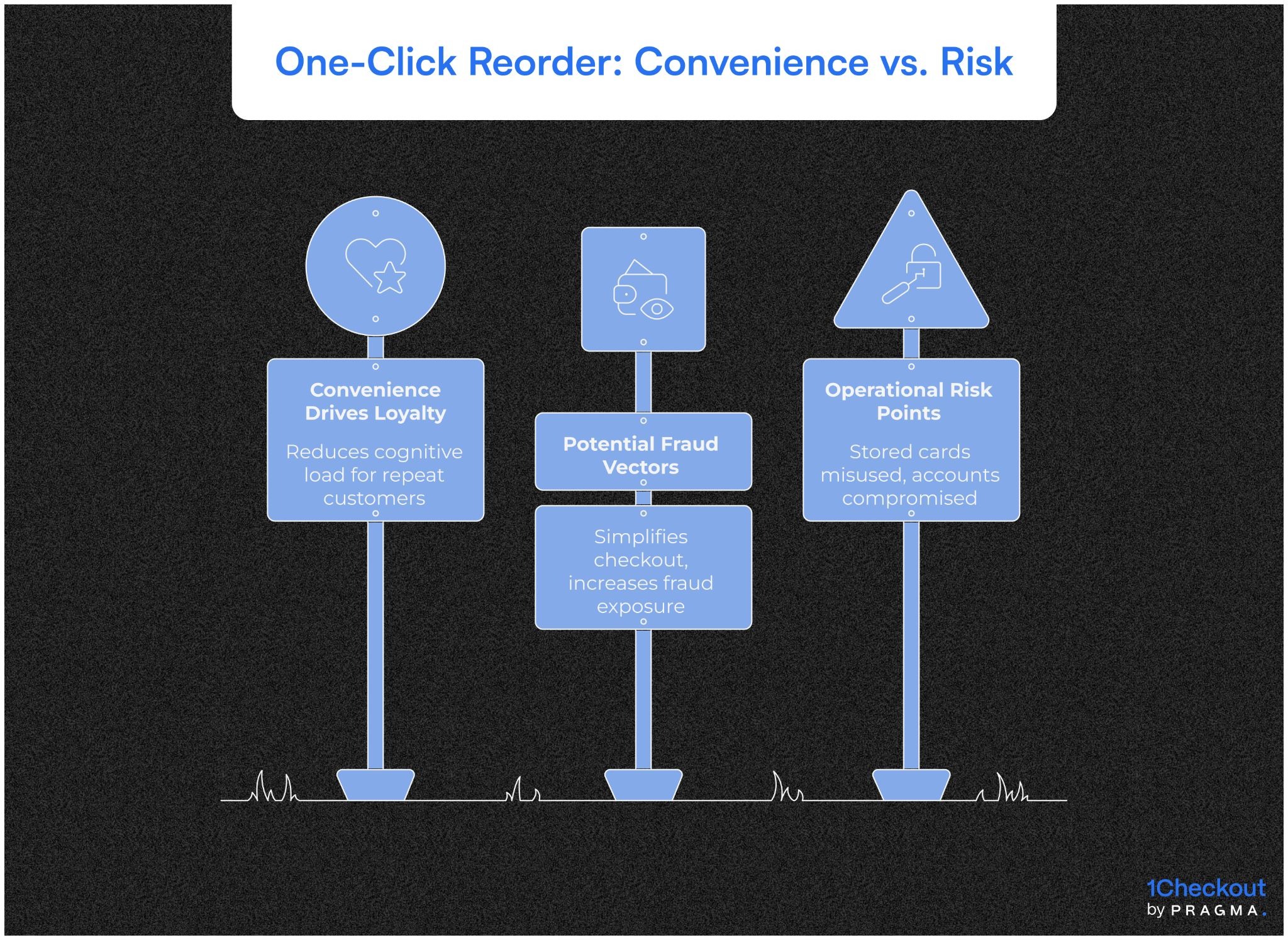
One-click reorder reduces cognitive load and friction for repeat customers. By allowing a familiar purchase to be completed in a single step, brands see higher repeat conversion rates, lower cart abandonment, and faster checkout cycles.
Operational implications
While UX improves, operations teams face challenges in ensuring that the streamlined process does not bypass critical verification steps, such as payment authentication, address confirmation, and order validation.
Potential fraud vectors
Simplifying checkout increases exposure to fraud if safeguards are insufficient. Fraudulent actors may exploit saved payment details, use stolen accounts, or abuse promotional incentives.
Operational risk points
- Stored cards being misused
- Compromised accounts placing high-value orders
- Automated scripts exploiting the one-click path
Ops teams need event-level visibility to detect anomalous behaviour and flag suspicious activity in real time.
Event logging and monitoring for one-click reorder
Visibility at every step prevents operational surprises
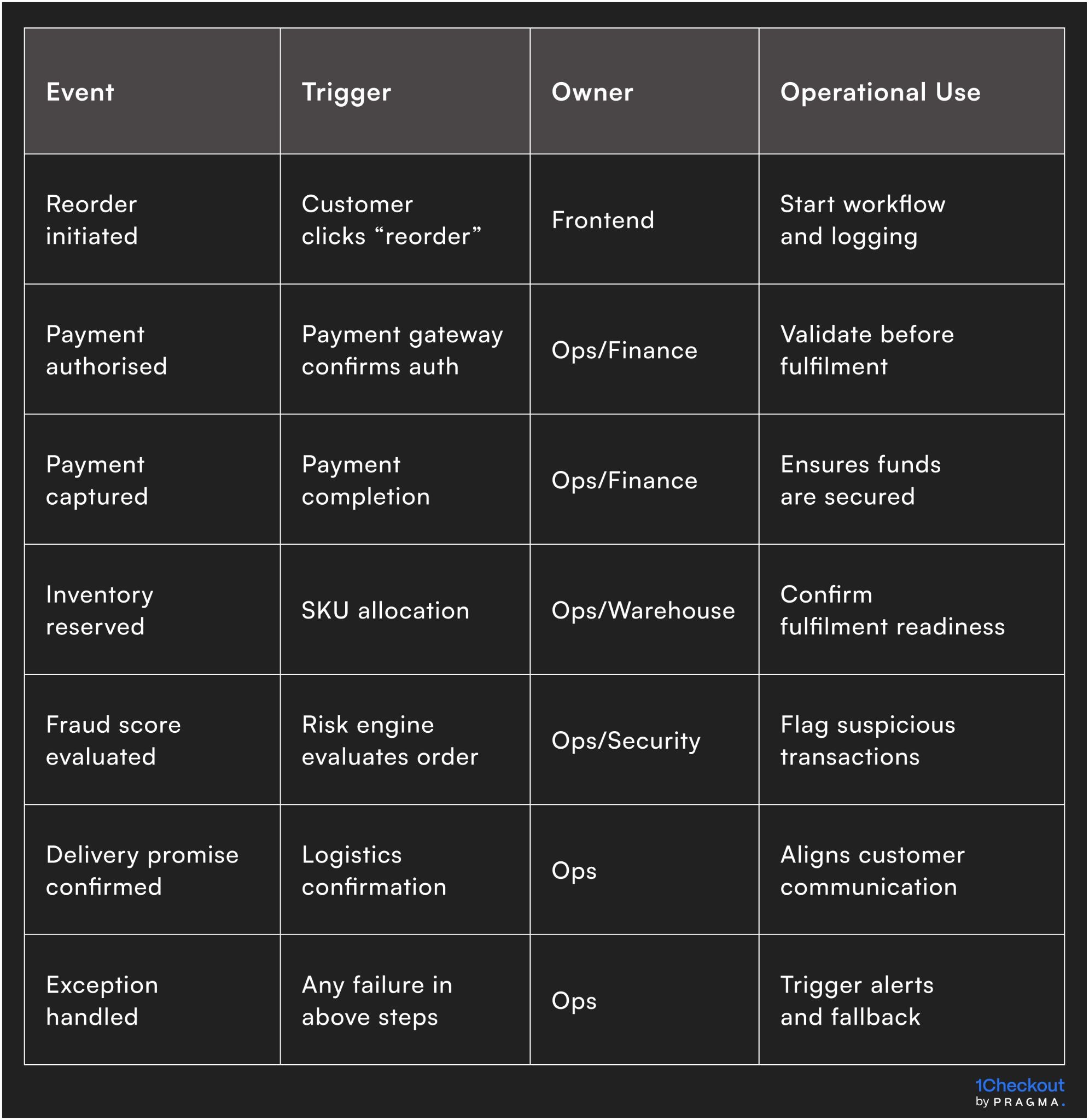
Minimum events to capture

For effective risk management, key events must be logged during one-click reorder:
- Order initiated
- Payment authorised and captured
- Inventory reserved
- Delivery promise confirmed
- Fraud score evaluation
Operational benefits
Logging these events provides a clear audit trail for troubleshooting failed orders, disputed transactions, or flagged accounts, enabling ops teams to act quickly without impacting legitimate buyers.
Exception handling in real time
Orders may fail due to inventory drift, payment decline, or fraud triggers. Operations must handle exceptions gracefully while preserving UX.
Example
If payment is declined, the system can offer immediate alternative payment methods rather than cancelling the order silently. Alerts to ops teams enable rapid intervention for high-value or priority transactions.
One-click reorder event framework
Payment validation and risk scoring
Ensuring fast transactions don’t compromise security
Layered payment checks
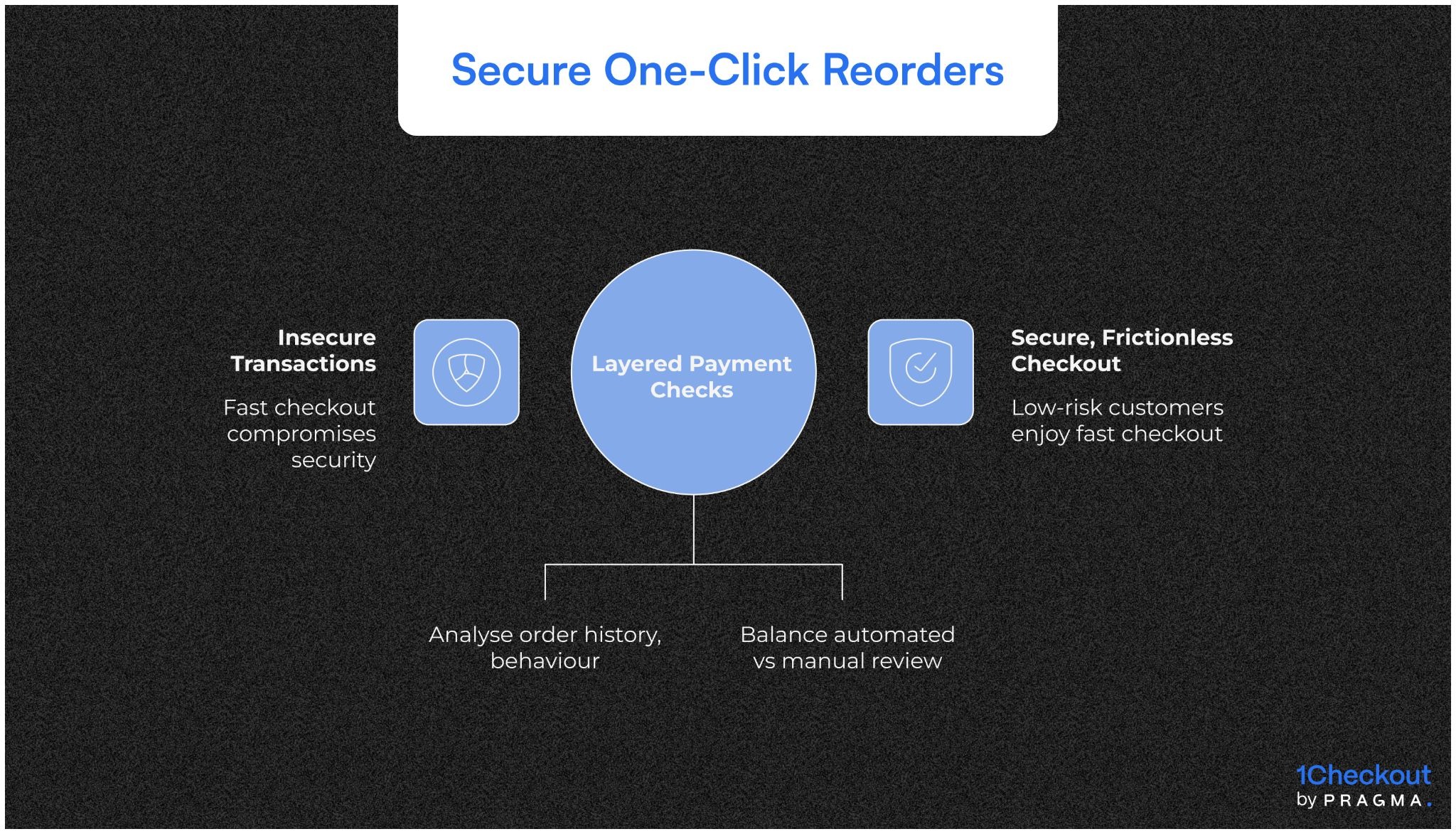
Even in one-click reorders, payments must be validated. Ops teams should integrate real-time risk scoring, analysing order history, payment method, and device behaviour. High-risk scores trigger additional verification or manual review before fulfilment.
Operational impact
Layered checks minimise chargebacks and fraud while allowing low-risk customers to enjoy frictionless checkout. Logging these events creates traceable insights for compliance and audit purposes.
Balancing automated vs manual review
Not every flagged transaction requires human intervention. Operations can define thresholds for automatic approval, secondary verification, or manual review based on order value, customer trust score, and historical behaviour.
Example
A repeat customer with a history of successful transactions may bypass manual review, whereas a high-value first-time reorder triggers additional verification before processing.
Strengthening account security without disrupting repeat purchase speed
Adding invisible safeguards that protect users without adding friction
One-click reorder depends heavily on account-level trust. Since transactions are initiated with minimal user input, securing the customer account becomes just as critical as securing the payment itself.
Device and session verification
Instead of prompting users for repeated authentication, systems can validate trusted devices and active sessions in the background. Recognising returning devices, IP consistency, and session continuity allows low-risk users to proceed बिना interruption, while flagging anomalies silently.
For example, if a reorder is triggered from a new device or unusual location, the system can require lightweight verification such as OTP confirmation—only when necessary.
Tokenisation and secure storage of payment methods
Stored payment instruments should never be directly accessible. Tokenisation ensures that sensitive card or banking details are replaced with secure tokens, reducing exposure even if account access is compromised.
This allows one-click checkout to remain fast while ensuring compliance and reducing fraud risk from stored credentials.
Adaptive authentication layers
Instead of static rules, authentication should adapt to risk signals. Low-risk reorders flow seamlessly, while high-risk attempts trigger step-up verification.
This ensures that security measures scale dynamically with risk rather than slowing down every transaction unnecessarily.
Outcome
By strengthening account-level security intelligently, brands can maintain a frictionless reorder experience for genuine users while preventing misuse at the source.
Leveraging behavioural signals to detect anomalies in repeat orders
Using customer patterns to differentiate genuine activity from fraud
Repeat buyers exhibit predictable behaviours—purchase frequency, order value ranges, preferred SKUs, and timing patterns. These signals can be leveraged to detect anomalies without relying solely on payment validation.
Establishing behavioural baselines
Operations systems should build profiles for repeat customers based on historical data. This includes:
- Average order value and frequency
- Common delivery locations
- Preferred payment methods
- Typical purchase timings (e.g., sale periods vs regular days)
These baselines act as reference points for identifying unusual activity.
Real-time anomaly detection
When a one-click reorder deviates significantly from established patterns, it can be flagged for additional checks. For instance:
- A sudden spike in order value
- Change in delivery location to a high-risk zone
- Multiple rapid reorders within minutes
Such deviations may indicate account compromise or fraudulent intent.
Silent intervention vs hard blocks
Not all anomalies should result in order rejection. Systems can apply graded responses:
- Soft flags for monitoring
- Step-up authentication for moderate risk
- Manual review or temporary hold for high-risk cases
This layered approach prevents unnecessary disruption to genuine customers while still controlling risk.
Outcome
Behavioural intelligence allows brands to move beyond static fraud rules, enabling smarter, context-aware decision-making that preserves both UX and security.
Designing safeguards against accidental reorders and user errors
Preventing unintended purchases while maintaining simplicity
While fraud is a major concern, accidental orders are an equally important operational risk in one-click reorder flows. Misclicks, unclear confirmations, or shared devices can lead to unintended transactions, resulting in cancellations, returns, and support overhead.
Confirmation design without friction
A completely “blind” one-click flow can increase accidental orders. Introducing lightweight confirmation cues—such as a quick review screen or a swipe-to-confirm action—can reduce errors without significantly slowing down the process.
The goal is not to reintroduce full checkout steps, but to provide a moment of clarity before order placement.
Easy cancellation windows
Providing a short, clearly communicated cancellation window immediately after reorder helps mitigate accidental purchases. Customers should be able to cancel or modify orders بسهولة from their account or confirmation message.
This reduces support tickets and prevents negative customer experiences.
Visibility into order details
Customers should have clear visibility into what is being reordered—SKU, quantity, price, and delivery details—before and immediately after placing the order.
Ambiguity in order details is a common cause of disputes and dissatisfaction, especially during fast-paced sale periods.
Outcome
Addressing accidental reorder risks ensures that UX improvements do not backfire into operational inefficiencies or customer frustration.
Aligning one-click reorder with loyalty and retention strategies
Maximising repeat revenue while maintaining controlled risk exposure
One-click reorder is not just a checkout feature—it is a powerful retention lever. When aligned with loyalty programmes and customer segmentation, it can drive predictable repeat revenue without increasing risk disproportionately.
Targeting high-trust customer segments
Not all users should have identical one-click capabilities. Brands can enable the fastest reorder flows for high-trust segments—customers with consistent purchase history, low return rates, and verified payment behaviour.
Lower-trust segments can still access reorder functionality but with additional safeguards.
Integrating rewards without abuse risk
Offering incentives for repeat purchases—such as discounts or loyalty points—can increase adoption of one-click reorder. However, these incentives must be tied to fraud checks to prevent abuse through multiple rapid transactions or fake accounts.
Predictable demand and operational planning
Repeat orders generated through one-click flows provide valuable signals for demand forecasting. Ops teams can anticipate inventory requirements, warehouse load, and delivery capacity more accurately.
This alignment reduces fulfilment delays and ensures that the convenience offered at checkout is matched by reliable delivery performance.
Outcome
When integrated thoughtfully, one-click reorder becomes a strategic growth lever—driving retention, improving forecasting, and maintaining controlled operational risk.
Exception management and fallback strategies
Minimising disruption while protecting revenue
Handling failed payments
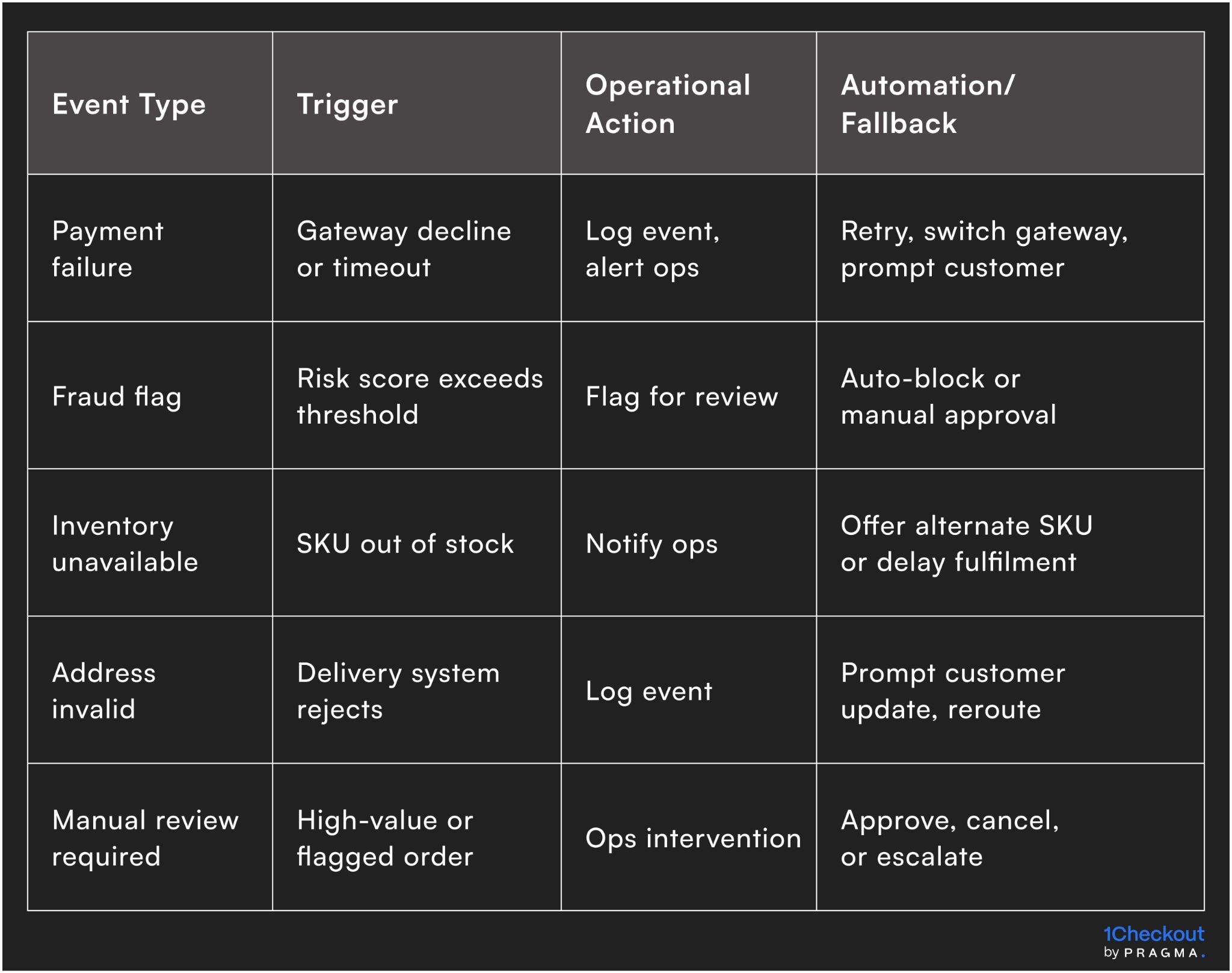
If a payment fails during a one-click reorder, automated fallbacks should be in place: alternate gateways, saved secondary payment methods, or customer prompts. Ops teams monitor these flows to ensure seamless recovery without user friction.
Reducing operational overhead
Automating fallback reduces manual ticket resolution, avoids delayed shipments, and ensures high-value orders are salvaged without creating negative experiences.
Address or inventory exceptions
Even repeat orders may fail due to stockouts or delivery restrictions. Logging these exceptions and offering immediate rerouting or alternatives keeps UX smooth while giving ops teams actionable data.
Operational benefit
Proactive exception handling prevents RTOs, failed deliveries, and customer complaints, maintaining trust in one-click reorder functionality.
One-click reorder risk and exception handling framework
Metrics to track for one-click reorder performance
Ensuring UX gains without compromising fraud controls

Tracking these metrics allows teams to balance speed and security, ensuring seamless repeat purchases while keeping risk under control.
To Wrap It Up
One-click reorder boosts repeat purchases and UX, but without operational controls, it can introduce fraud, failed payments, and customer dissatisfaction. A robust combination of event logging, layered payment validation, fraud scoring, fallback strategies, and exception management ensures repeat buyers enjoy speed without compromising security.
This week, implement logging for all critical reorder events and set up risk scoring thresholds for high-value transactions.
Over the long term, maintain automated fallback workflows, monitor key metrics, and refine fraud controls continuously to scale one-click reorder safely.
For D2C brands seeking frictionless yet secure repeat purchase flows, Pragma’s operations orchestration platform provides event tracking, risk scoring, and automated exception handling that help brands increase repeat revenue while minimising fraud and operational disruptions.
.gif)
FAQs (Frequently Asked Questions On One-click reorder: balancing UX gains and fraud controls for repeat buyers)
1. What makes one-click reorder risky?
Streamlined checkout reduces verification steps, potentially allowing payment fraud, unauthorised orders, or accidental purchases.
2. Which operational events are essential to log?
Order initiation, payment authorisation and capture, inventory reservation, fraud score evaluation, delivery promise confirmation, and exception handling.
3. How can fraud risk be minimised without hurting UX?
By using real-time risk scoring, layered validation, and automated fallback strategies for high-risk transactions while low-risk repeat buyers proceed frictionlessly.
4. What happens if a one-click reorder fails?
Automated fallback retries, alternative payment routing, or ops team intervention prevent lost revenue and customer dissatisfaction.
5. How do operations teams balance speed and security?
Through exception logging, layered checks, and prioritised manual reviews for high-value or flagged transactions, ensuring repeat buyers enjoy seamless UX.



.svg)
.svg)